At PSM Industries, Inc., we combine advanced engineering with proven manufacturing technologies to produce high-performance metal and plastic components. Through our specialized divisions (Pacific Sintered Metals, PM Engineered Solutions, Polyalloys Injected Metals, and Yillik Precision Carbides), we deliver precision parts that meet demanding performance and volume requirements across multiple industries.
Whether you need powder metal (PM) parts, metal injection molded (MIM) components, or custom-molded plastics, our team brings decades of experience and a commitment to quality that drives reliable, repeatable results.
The process begins with carefully selected metal powders. These powders come in different grades and alloy types such as stainless steel, copper, low-alloy steels, brass, and bronze. As experienced powder metal component suppliers, we know that consistency in particle size and composition directly affects the performance of the final part. To prepare them, powders are blended with lubricants that help improve compaction and create a uniform mix.
Once the blend is ready, it’s pressed in a die under high pressure to form what’s called a “green part.” This step is crucial because the pressure determines the density and strength of the finished component. Compaction is not only material-efficient but also highly productive—the process can exceed 1,000 parts per hour, making it ideal for large-scale production. It also allows for shapes that would be wasteful or difficult to machine or form from solid metal.
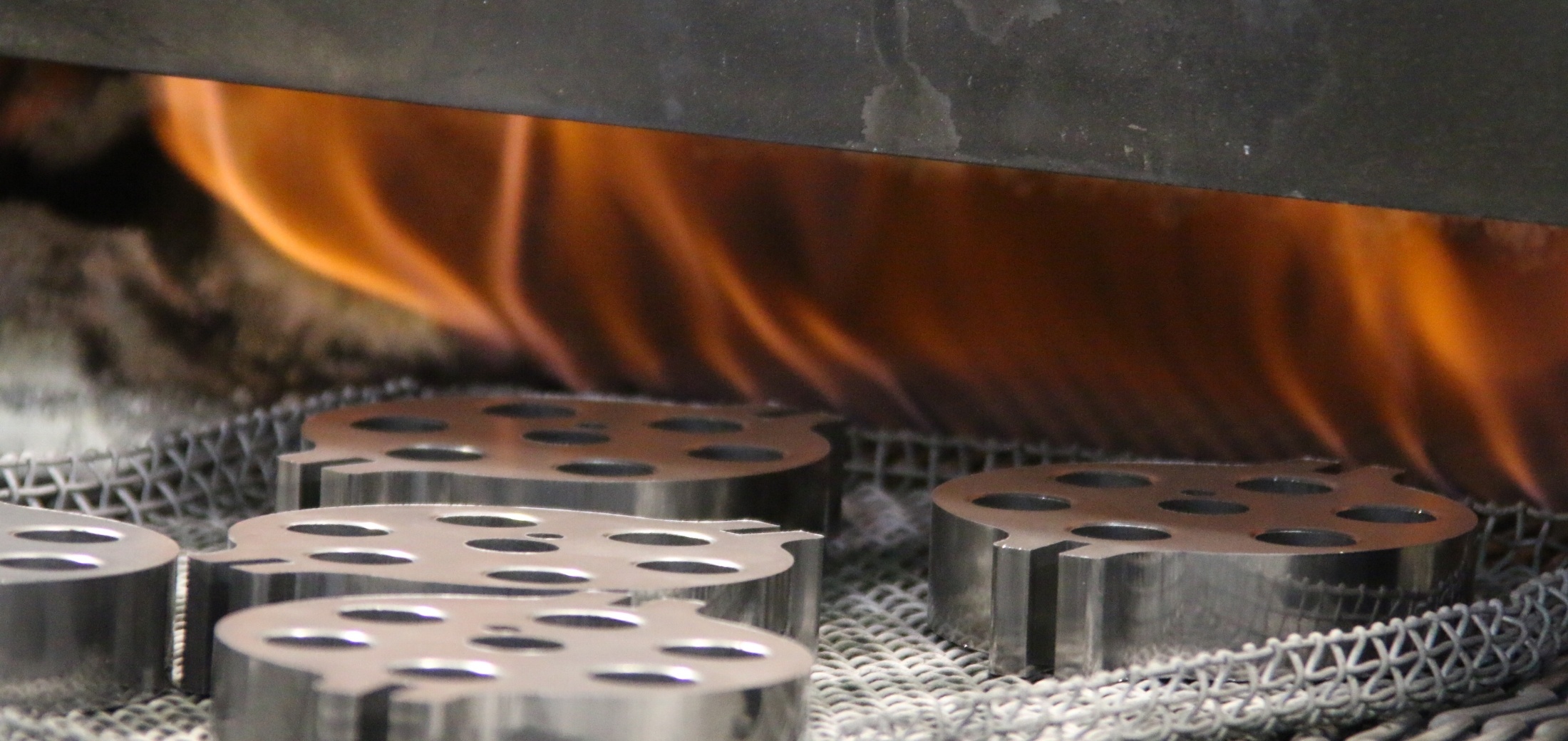
After compaction, the green part is sintered. Sintering involves heating the compacted part in a tightly controlled furnace in a reducing atmosphere at a temperature just below the metal’s melting point. This causes the particles to fuse together, increasing strength and durability. The result is called a PM part–a solid component with excellent structural integrity and precision.
Depending on customer requirements, powder metal parts may go through finishing operations such as coining, machining, plating, or heat treatment. These steps enhance strength, wear resistance, dimensional accuracy, appearance, or corrosion protection. As-sintered PM components can commonly maintain tolerances in the range of approximately ±0.001” to ±0.005” depending on geometry and material composition, while secondary sizing, machining, grinding, or honing operations can achieve significantly tighter tolerances on critical features. Whether its gears, bushings, or structural parts, powder metallurgy gives manufacturers a reliable way to produce consistent components with repeatable dimensional control at production scale.
The Yillik Precision Carbides division manufactures precision tungsten carbide components engineered for extreme wear resistance, dimensional stability, and long service life in demanding industrial applications. Using advanced powder metallurgy processes, Yillik produces carbide bushings, bearings, guides, dies, seal rings, rollers, and custom wear components for industries requiring high-performance materials and tight tolerances.
Yillik performs carbide pressing, sintering, grinding, and finishing operations in-house, providing greater control over material consistency, dimensional repeatability, and production quality. Components are compacted into near-net shapes, green machined for added complexity, and sintered under tightly controlled conditions to achieve dense, wear-resistant carbide structures.
To maintain precision throughout manufacturing, Yillik compensates for dimensional shrinkage during the sintering process through tooling development, controlled processing parameters, and secondary grinding and honing operations. Critical features are precision finished to support close tolerances, concentricity, and repeatable performance in critical applications.
The division’s manufacturing capabilities include precision-ground carbide components with IDs, ODs, and faces held within 0.0002” TIR for demanding drilling and tooling applications. Combined with advanced finishing processes and engineered carbide grades, Yillik delivers tungsten carbide solutions built for durability, accuracy, and extended production life.
While powder metallurgy is excellent for medium-to-large production runs, some parts require more unique geometry, higher material properties, and tighter tolerances - that's where MIM comes in.
MIM starts with the preparation of feedstock. Fine metal powders are combined with a binder made of polymers and waxes to form a moldable material. The binder allows the mixture to flow easily when heated under pressure during injection molding, much like plastic.
The feedstock is injected into a mold to create a “green part.” This step allows for complex shapes, thin walls, and features that would be difficult or expensive with other methods. Polyalloys has built its reputation as one of the leading metal injection molding companies because of our ability to produce intricate designs while maintaining consistency.
After molding, a portion of the binder material is carefully removed through a vacuum debinding process. This leaves behind a measured combination of spherical metal powders and binder imparting sufficient part strength to be handled prior to the final processing.
In a manner similar to powder metallurgy, the molded parts are sintered in a high-temperature furnace in a reducing atmosphere. The process removes the remaining binder and fuses the metal particles together, producing sintered metal parts with densities up to 95–99% of wrought material.
As densification occurs, the component experiences predictable dimensional shrinkage. Tooling geometry and process parameters are carefully developed to compensate for this shrinkage and maintain close dimensional tolerances throughout production.
The resulting density provides excellent mechanical properties, making MIM components suitable for highly demanding and critical applications.
Depending on the end use, MIM parts may undergo additional steps such as heat treatment, polishing, or coatings. For example, medical device components often require smooth surfaces and corrosion resistance, while aerospace parts may need heat treatment to withstand high stress.
Powder metallurgy (PM), metal injection molding (MIM), and precision tungsten carbide manufacturing provide efficient, scalable solutions for producing complex, high-performance components.
As part of the PSM Industries family, the PMES Plastics Division delivers comprehensive plastic molding capabilities designed for both high-volume and specialized production needs. With over 60 molding machines in operation and decades of experience in thermoset and thermoplastic processing, PMES provides durable, high-quality parts for industries such as electrical, aerospace, medical, and industrial equipment.
Our thermoset compression and transfer presses, ranging from 60 to 350 tons, can handle a wide variety of materials and part sizes—from just a few grams to over five pounds. These processes are ideal for high-strength, heat-resistant components that require dimensional stability under pressure and temperature. We work with materials such as:
These resins are selected for their excellent electrical insulation, chemical resistance, and mechanical properties—making them perfect for demanding industrial and electrical applications.
Our injection molding presses range from 25 to 650 tons, giving us the flexibility to handle projects of nearly any scale. We process both thermoset and thermoplastic materials, including:
We mold general-purpose and engineering-grade thermoplastics, producing precision components with complex geometries and fine surface finishes. This versatility allows us to serve diverse customer requirements—from rugged industrial housings to aesthetic consumer parts.
With experience across both thermoset and thermoplastic systems, our plastics team provides flexibility in part design, material selection, and performance optimization. Whether the goal is heat resistance, electrical insulation, chemical stability, or strict cosmetic requirements, we can recommend the best resin system and molding process for the job. Our capabilities also include insert molding, precision machining, and full assembly, allowing us to deliver complete, ready-to-use components that meet exacting specifications.
PSM Industries supports a wide range of markets by supplying both PM, MIM and plastic components. Our processes are flexible enough to meet specific performance, volume, and cost requirements for a wide range of industries including:
By serving these industries through Pacific Sintered Metals, Polyalloys Injected Metals, and the PMES Plastics Division, PSM Industries continues to demonstrate its capability as a single-source partner for high-quality metal and plastic components.
Choosing a manufacturing partner isn’t just about who can make the part—it’s about who can consistently deliver results. Here’s why customers continue to work with us:
Ready to take your project to the next level? PSM Industries, Inc. unites specialized manufacturing divisions:
We give you unmatched flexibility, consistency, and scalability for any application. Contact us today to discuss your next project and see how we can help bring your product to life!
Fill out the form below and one of our qualified engineers will respond to your question.

14000 Avalon Blvd.
Los Angeles, CA 90061
Phone: (310) 715-9800
Fax: (310) 715-1414
Email: info@psmindustries.com